


Smart Manufacturing
Landing Practice of the Application Development Security Control Platform in Smart Manufacturing
Business Requirements
As a pioneer in the digital transformation of the automotive industry, a well-known domestic joint-venture brand boasts a large-scale and complex software supply chain. The enterprise operates nearly hundreds of existing IT systems, which are continuously iterated, expanded, and deployed across private and public cloud environments. Open-source components are widely adopted, with 78% to 90% of applications containing open-source code. However, industry data indicates that 47% of new versions of these components have vulnerabilities, and only a small number of them are effectively notified and remediated, resulting in extremely high security risks from third-party components. During the development process, developers fail to systematically document the list of used components, making it impossible to quickly locate and fix vulnerabilities when they occur. Moreover, the cost of vulnerability remediation surges to 30 times higher after deployment than before.
In addition, regarding the R&D and operations security system, although the enterprise has established a DevOps R&D process and toolchain, security tools are managed in a fragmented manner, lacking a unified platform to integrate SAST/IAST/SCA and other tools. Developers and security personnel need to frequently switch between tools to view reports, leading to unordered retesting scheduling. Detection results rely on manual collection and judgment, with no ability to automatically block the R&D pipeline. There is a lack of security situation analysis, insufficient key data such as TOP vulnerabilities and project security comparisons, and security reviews lack informationized records and knowledge base support. These issues have severely restricted the efficiency of software supply chain security governance and become a bottleneck for the rapid advancement of business under the agile development model.
Solution
Technical Architecture
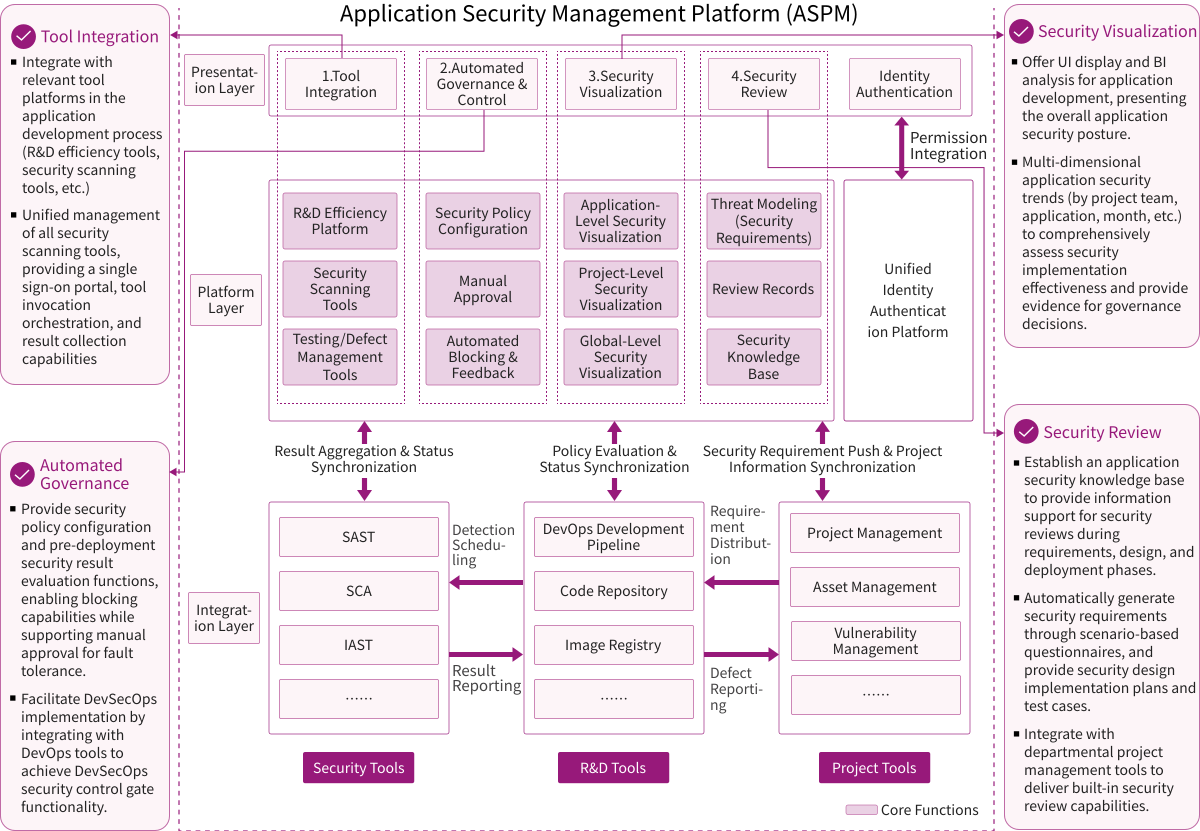
Based on the complex application development environment of this joint-venture manufacturing brand, the solution constructs a hierarchical, distributed, and highly integrated technical architecture that comprehensively covers the full-lifecycle management of application security.
The infrastructure layer is deeply adapted to the enterprise’s private cloud development environment and public cloud development platforms, utilizing containerization technology to encapsulate various security tools and platform services. This design enables flexible resource allocation based on business loads—whether computing, storage, or network resources—achieving efficient utilization and ensuring the system operates stably amid the continuous iteration and update of massive IT systems.
As the core of the architecture, the platform layer comprises four key modules: Unified Management, Automated Control, Security Situation Analysis, and Informationized Security Review. The Unified Management module deeply integrates multiple security testing tools (including SAST, IAST, SCA) and server detection tools through standardized interface protocols, breaking down information silos between tools. Developers and security personnel can perform one-stop operations for all security tools via the Application Development Security Control Platform, including task scheduling and report viewing. The Automated Control module is deeply integrated into the DevOps R&D process and toolchain, establishing an automated data collection and processing mechanism. It analyzes security detection results in real time, accurately judges potential risks based on preset security policies, and blocks applications with security vulnerabilities from entering the next R&D phase.
The application presentation layer provides users with an intuitive and user-friendly interface, displaying security situation analysis data (such as TOP vulnerability statistics, project security comparisons, and security rankings) through visual charts and reports. Meanwhile, it fully supports online security review operations, realizing the informationized recording and storage of security requirements and review results for convenient retrospective access.
In addition, the platform achieves integration with multiple key internal enterprise systems:Synchronizes application information by connecting to the technical service platform (IWORK);Enables internal user single sign-on (SSO) redirection;Initiates and concludes various review processes by linking to the project management platform;Implements toolchain invocation, result synchronization, and security release control based on quality thresholds through integration with the DevOps platform.These integrations further enhance the platform’s interoperability and practicality.
Achievements & Benefits
01 Significantly Improved R&D Efficiency and Shortened Development Cycles
The Application Development Security Control Platform realizes unified management and scheduling of security tools:Average operation time for a single security testing task reduced by ~40%;Efficiency of security report viewing and analysis improved by 35%;Overall delivery cycle of individual projects shortened by ~15% on average, ensuring the timely launch of new business functions.
02 More Efficient Vulnerability Management and Reduced Remediation Costs
Leveraging powerful comprehensive detection capabilities, the platform delivers remarkable results:Application-layer vulnerability detection accuracy increased by ~25%;Average vulnerability handling cycle shortened by ~30%;Average remediation cost per vulnerability reduced by ~60%, effectively minimizing potential economic losses and business risks caused by vulnerabilities.
03 Upgraded Security Management Capabilities and Knowledge Empowerment for Development
The Security Situation Analysis module provides managers with intuitive data support. Based on project security scores, vulnerability statistics, and other information:Accuracy of security management decisions improved by ~25%;Efficiency of security issue resolution enhanced by ~30%;Time required to master security development-related knowledge reduced by ~40%.This promotes the continuous improvement of the enterprise’s secure development capabilities and contributes to the refinement of software supply chain security governance systems in the smart manufacturing industry.